
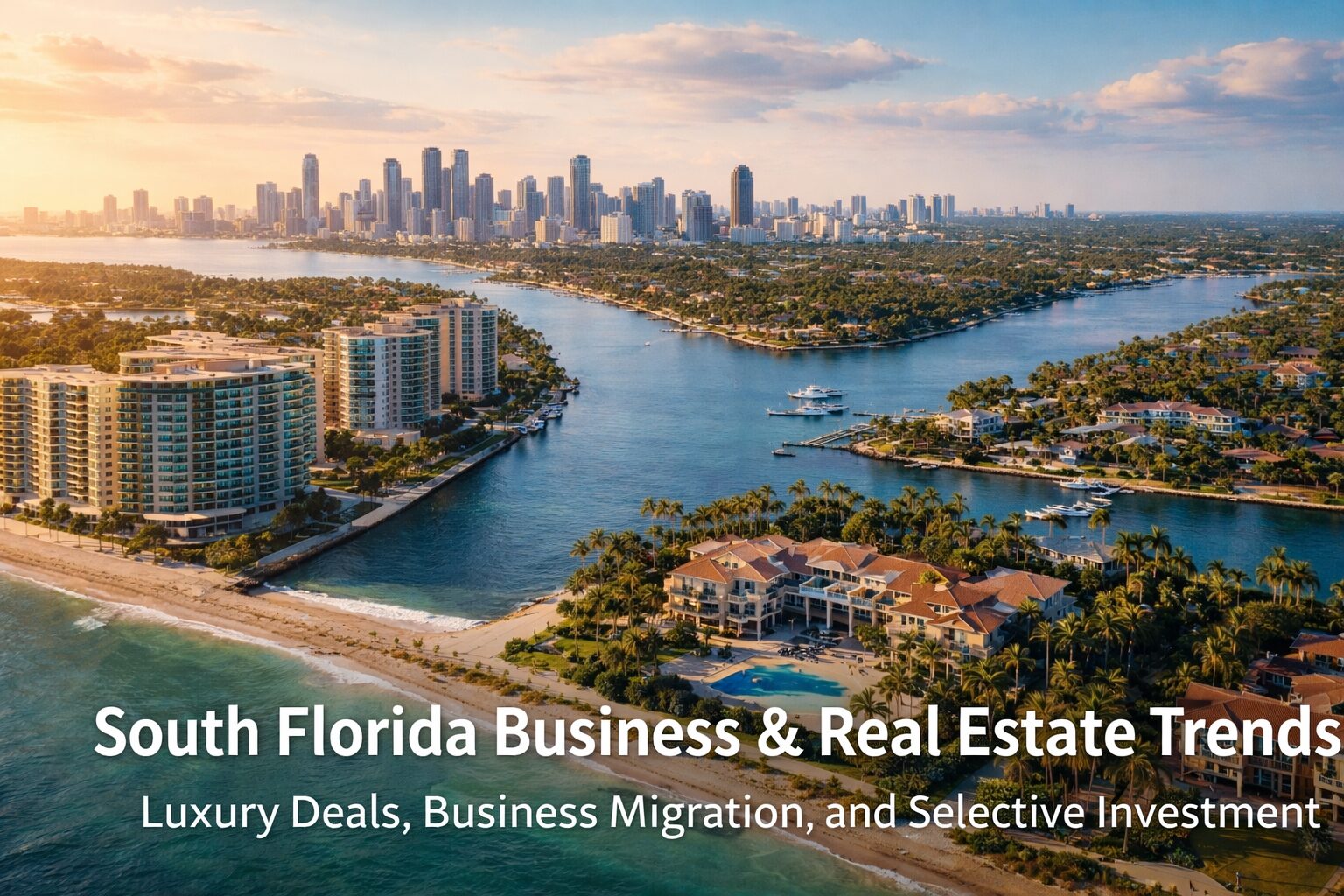
As 2025 winds down, South Florida’s business and real estate markets are doing what they’ve done best over the past several years: defying simple narratives. While national headlines debate cooling markets and cautious capital, deal activity across Miami-Dade, Broward, and Palm Beach counties suggests something more nuanced is unfolding—one defined by selective confidence, ultra-high-net-worth interest, and strategic bets on lifestyle-driven growth.
Ultra-Luxury Still Sets the Pace
At the very top of the market, South Florida remains in a category of its own. A recent record-setting condominium sale in Surfside underscored that demand for rare, oceanfront assets has not softened—even as interest rates and global uncertainty remain in play. These types of transactions are less about timing the market and more about scarcity, privacy, and long-term wealth preservation. For buyers operating at this level, South Florida is not a short-term play; it’s a global safe harbor.
That same theme echoed farther north in Palm Beach County, where a newly listed ocean-to-Intracoastal estate in Manalapan drew immediate attention. Properties with dual-water frontage, modern construction, and estate-level acreage are increasingly viewed as legacy assets. While the broader residential market may be recalibrating, the uppermost tier continues to function on its own economic logic.
Palm Beach’s Business Migration Shows Staying Power
Beyond trophy properties, Palm Beach’s evolution as a business and finance hub continues to accelerate. Seasonal residents are no longer simply wintering in South Florida—they’re expanding their footprints, opening offices, and embedding themselves into the local economy.
This past week’s buzz around Palm Beach’s dining, hospitality, and social scene may read as lifestyle coverage on the surface, but the underlying story is economic. Restaurants, private clubs, and high-end hospitality tend to follow capital. Their growth signals confidence that executives, investors, and entrepreneurs aren’t just passing through—they’re building long-term lives and businesses in the region.
For commercial landlords and developers, this shift has real implications. Demand is rising for boutique office spaces, flexible work environments, and mixed-use projects that blend business, wellness, and social connection—especially in walkable, amenity-rich districts.
Broward’s Quiet Strength
While Miami often dominates the headlines, Broward County continues to benefit from a quieter, steadier form of growth. Fort Lauderdale, in particular, is gaining traction with executives and companies seeking proximity to Miami without Miami’s price volatility.
Recent data points to increased interest in rentals and flexible living options in Broward, reflecting both affordability considerations and evolving work patterns. For investors, this signals opportunity in well-located multifamily, mixed-use developments, and adaptive reuse projects that cater to professionals prioritizing quality of life alongside access to major business centers.
Broward’s appeal also lies in its infrastructure investments—from transportation to waterfront redevelopment—which continue to support long-term value creation rather than speculative spikes.
Civic Decisions with Development Consequences
Not all real estate news is transactional. A recent legal ruling clearing the way for a high-profile civic development in Miami highlights the outsized role that public-sector decisions play in shaping private investment. Land use, zoning approvals, and institutional partnerships can redefine entire neighborhoods, influencing everything from surrounding property values to infrastructure planning.
For developers and investors, these moments matter. They offer reminders that understanding local governance and political dynamics is just as critical as underwriting a deal.
A Market Defined by Selectivity
What ties this week’s developments together is selectivity. Capital is not retreating from South Florida—it’s becoming more discerning. The strongest activity is concentrated around assets and locations that offer a compelling mix of lifestyle, long-term fundamentals, and scarcity.
Luxury residential remains resilient. Business migration continues to favor Palm Beach and Broward alongside Miami. Hospitality and experiential real estate are expanding in tandem with executive relocations. And civic decisions are setting the stage for the next wave of development.
As 2026 approaches, South Florida’s outlook isn’t about boom or bust—it’s about evolution. The region is maturing into a multi-market ecosystem where different counties serve different buyer profiles, business needs, and investment strategies.