
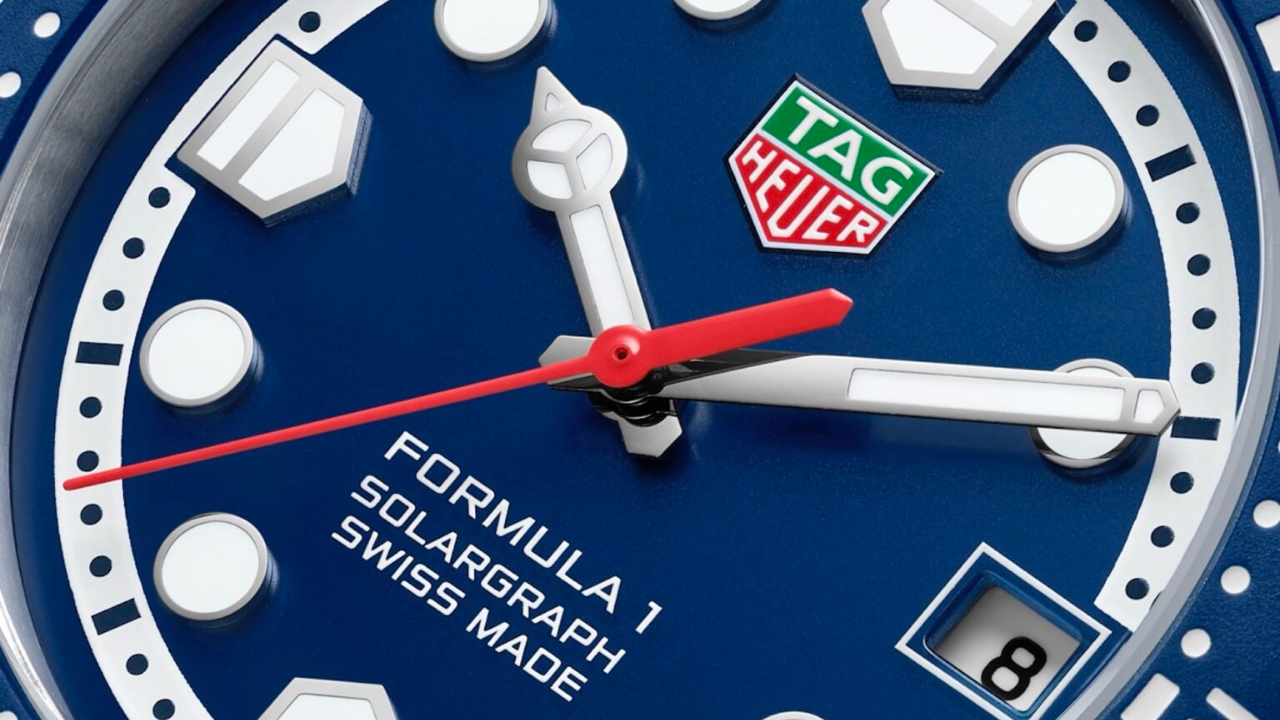
TAG Heuer is back where it belongs—on the grid. In 2024, the Swiss watchmaker inked a high-profile deal to return as the Official Timekeeper of Formula 1, nearly a decade after stepping away. For 2025, the partnership accelerates with the relaunch of its Formula 1 collection, a line first introduced in 1986 that went on to sell more than three million units and became a global cultural icon.
The move is more than nostalgia. The new F1 models showcase TAG Heuer’s Solargraph TH50-00 calibre, a solar-powered innovation where just two minutes of sunlight fuels a full day of precision timekeeping. Nine new race-specific designs—debuting in markets from Mexico to Singapore—position the collection as both a nod to heritage and a forward-looking play in sustainable luxury.
For TAG Heuer, the alignment couldn’t be more strategic. Formula 1 has never been more valuable, attracting record audiences, expanding into new markets, and capturing younger consumers who crave access to luxury with speed, technology, and spectacle built in.
From Quartz Crisis to Market Triump
The original Formula 1 collection was born from disruption. In the 1980s, the Swiss watch industry was reeling from the Quartz Crisis, as Japanese competitors eroded market share. TAG Heuer responded with something few heritage brands dared: brightly colored, affordable quartz watches built with fiberglass and steel.
Priced in the hundreds, they struck a chord with surfers in California and urban tastemakers in Europe. More than three million units sold in a decade, making it one of the most successful product launches in Swiss watchmaking history.
Discontinued years later, the collection has surged back in relevance. A recent collaboration with New York-based lifestyle brand Kith reignited demand, with resale prices for vintage F1 models climbing sharply on the secondary market. The 2025 relaunch builds on that momentum, giving TAG Heuer an opportunity to capture a new generation of collectors while reasserting its legacy in motorsport.
A Half-Century on the Track
The partnership between TAG Heuer and Formula 1 isn’t just a marketing play—it’s a shared history. In 1971, Heuer became the first watchmaker to sponsor a Formula 1 team, Ferrari, even negotiating with Enzo Ferrari himself. By offering custom-made watches instead of cash sponsorships, Heuer set a precedent for brand equity that resonated with drivers and fans alike.
The legacy deepened with McLaren in the mid-1980s, an era defined by Ayrton Senna’s dominance, Mika Häkkinen’s back-to-back championships, and the debut of Lewis Hamilton—who arrived at McLaren already wearing his own TAG. Over the decades, TAG Heuer’s logo became synonymous with racing triumphs, spanning more than 230 wins, 595 podiums, 11 Constructors’ Championships, and 14 Drivers’ Championships.
Perhaps even more transformative was TAG Heuer’s role in changing how the sport was experienced. As F1’s official timekeeper from 1993 to 2015, the brand introduced real-time lap timing for fans, turning the precision of horology into part of the live spectacle of racing.
Strategy in Motion
The brand’s trajectory hasn’t always been smooth. In the 2000s, an overextension into football diluted its motorsport identity, while the rise of smartwatches threatened to sideline its relevance with younger consumers. But since Frédéric Arnault became CEO in 2020, TAG Heuer has reengineered its positioning with clarity.
Partnerships with Porsche and now Formula 1 signal a return to its core DNA: speed, performance, and precision. The renewed timekeeping role is less about visibility alone—though the branding is priceless—and more about narrative alignment at a time when Formula 1 is expanding its global footprint and attracting luxury buyers in markets from Miami to Singapore.
For Arnault, the relaunch of the F1 collection is a statement: TAG Heuer is not just retelling its history—it’s rewriting the rules of what a heritage brand can be in a digitally driven, experience-first marketplace.