
Over the 2024 holidays, Rakesh Guduru paid about $50 for a portable charger from a vending machine at Disney World after his phone died. The bulky device and its cable left him unimpressed, and as a seasoned inventor, he knew he could design a better one.
Guduru came to the U.S. from Hyderabad, India, in 2008 to study for a master’s in biomedical engineering at FIU in Miami and stayed to earn his PhD in electrical and computer engineering. He has since earned more than 25 patents, and his designs have won a Red Dot Award along with honors in Germany and Australia. His first commercial product, CrazyCap, was a self-cleaning water bottle that used UV-C light to purify water. It was named one of Time’s 100 Best Inventions of 2020. “Ultimately, we closed the business because the market wasn’t big enough, and I carried that lesson into PETL,” Guduru said.
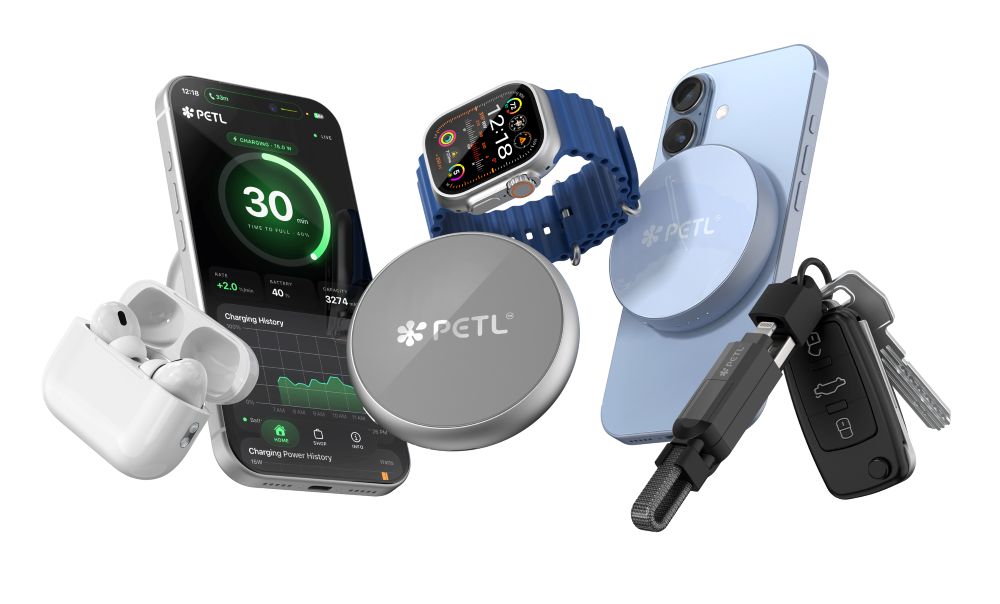
PETL is a circular, patent-pending portable charger that entered the consumer electrinics market in September 2025, about nine months after his trip to Disney. After a brief start in wireless carrier stores, the company moved to selling direct to consumers through goPETL.com. It reached profitability about 12 months into the business and has funded its growth through sales and credit rather than venture capital. More than 80,000 people now use PETL, and the company projects it will ship around 100,000 orders by the end of 2026.
Guduru, PETL’s CEO and co-founder, spoke with SFBW about financing inventory during hypergrowth and the one mistake he’d warn other founders to avoid.
SFBW: You went from paying about $50 for a portable charger from a theme park vending machine to launching PETL nine months later. What happened in between?
Rakesh Guduru: As a designer, I saw an opportunity to make a better one. It wasn’t my first hardware brand. With CrazyCap I’d already gained experience in manufacturing and had flown to China to source suppliers myself. I wanted design to be the central pillar of PETL. The problem is that nearly every power bank is a rectangle, and no amount of design makes a rectangle leave a lasting impression. The form factor had to change completely, which is how I landed on a circle. Portability was the priority, and a circle slides into a pocket or a small space where a rectangle’s corners get in the way.
SFBW: What did it cost to launch PETL, and how did you pay for it? When did PETL reach profitability, and have you raised money since or turned investors down?
RG: PETL was privately funded at launch. We didn’t go to venture capital, and we haven’t disclosed the figure. Our focus with PETL is growth. We’re growing about 30% month over month, and we reached profitability around 12 months into the business. Growth since launch has been funded by sales and credit, with no venture capital.
SFBW: PETL is now sold only at goPETL.com. Why make that choice?
RG: When we launched, PETL was in a few wireless carrier stores, and we quickly saw what that did to our cash. Retail terms added another 60 to 90 days before we got paid, and at that pace, it would have been impossible to scale.
So we went direct-to-consumer, online only, and that’s what allowed us to scale the business. We chose our own website over Amazon because it gives us direct access to the customer. The trade-off is that nobody stumbles across us on a shelf, so we have to reach every customer ourselves.
Would we ever say yes to a partner? On the right terms. We already get regular requests from companies that want PETL as a corporate gift, and we’re building a team for that.
SFBW: What’s the hardest part of selling a product in such a commoditized category?
RG: More than 80,000 people use PETL today, and they found us through our marketing and through word of mouth. A lot of PETLs are bought as gifts, which puts the product in the hands of people who had never heard of us.
The hardest part of this category is that every power bank looks the same, so it’s hard to give people a reason to choose one over another. Our answer was design, starting with a product that doesn’t look like anything else out there.
SFBW: Has growing that fast been easy or tough? What’s one mistake from year one you’d warn another founder about?
RG: It’s been tough, and the biggest challenge is financing inventory. Our products are built by contract manufacturers in China, which puts about 60 days between paying for inventory and having it to sell. At our growth rate, we have to plan at least 90 days ahead.
Most banks won’t lend to a company until it has years of operating history, and we were less than a year old. What helped us significantly was Shopify Capital. Our website runs on Shopify, so Shopify could see our growth and offered us financing almost instantly. We also borrowed from close friends and family, at interest, to fund inventory. I think this is the biggest challenge entrepreneurs face today.
When a company is in hypergrowth, you have to optimize everything. Otherwise, your losses scale right along with your revenue. You need to build systems that cut waste and improve efficiency, and that’s far easier today than it was a few years ago, thanks to advances in AI. We built our own sales dashboard and inventory forecasting tools in-house. Tools like these used to be available only to multibillion-dollar companies, and for a small business they were out of reach.
The one thing I’d warn another founder about is merchant cash advances. Shopify’s is better than most, but many of the deals from other funders are terrible. They’re easy to get, and they usually hurt the business more than they help. I would avoid them.
SFBW: What’s in the 2027 product pipeline, and where do you see PETL in three to five years?
RG: We’re bringing a new family of products to PETL, all built to improve the experience for PETL customers. Many entrepreneurs go down a rabbit hole trying to find a market for their product. The power of product-market fit is that the market finds your product, and when that happens, you see hypergrowth. That growth brings you a large base of customers, and you can offer your next invention to them at a much lower acquisition cost, because you already have the customer.
In three to five years, I want PETL to be a design-led brand people recognize on sight, the way they recognize Dyson or Apple, with a full family of products around the original.