

By Darcie Lunsford
It has been the proverbial Energizer Bunny of the post-recession real estate market. Boom, boom, boom goes the steady drumbeat of new rental apartments coming up across South Florida for the past seven years.
You can hardly traverse downtown Miami, Fort Lauderdale or Boca Raton these days without running into a construction snarl or towering crane resulting from the multifamily boom.
But the sun might be setting on the current construction cycle.
It’s setting up to be the type of subtle shift that commercial real estate markets prefer: New construction will taper off, rent growth will soften, and absorption will slow down until market demand catches back to supply. Then the cycle will begin anew.
“This year will be the peak for supply in this cycle,” predicts Michael Ging, managing director of Alliance Residential, which has built more than a half-dozen new apartment projects from downtown Miami to West Palm Beach during the current cycle. “Up until now, everything has been up, up, up. Everything has been great, but now what I think we are going to see is a moderation of market conditions.”
Terming it a “soft landing,” Ging says that year-over-year rent growth is already starting to slow from a robust 5 or 6 percent to about 3 percent. Leases of new projects also are going from 30-plus units a month to 20 to 25 units. That’s still solid, but not roaring.
Second-quarter data reveal that trend.
South Florida’s year-over-year apartment occupancy in the second quarter dropped 1.5 percent as the net supply of 11,329 units outpaced net demand by 2,450 units, according to MPF Research. But even with the delivery of thousands of new units, the region still posted a respectable 95.7 percent occupancy rate at the end of the second quarter.
Similarly, rents ticked up about 2.5 percent, which is below the region’s three-year average of 4.3 percent.
While the general trend of rising supply dragged on inventory absorption across the region, metropolitan Miami stands to have the greatest correction risk, according to MPF’s second-quarter report on market conditions.
Much of the construction has focused on megasized, high-rent, upscale towers in urban submarkets, such as downtown Miami, South Beach and Coral Gables, and “supply has begun to weigh on Class A occupancy,” MPF economists conclude. Adding to that, a large inventory of new, for-sale condos that are for rent—known as the “shadow market”—stands to siphon affluent renters from traditional luxury apartments.
Miami-Dade County’s apartment sector is the only one in South Florida to dip into negative absorption territory. Demand, as measured by net absorption of total units in the market, peaked in early 2016, and then fell going into to 2017, with negative annual absorption of 1,262 units recorded in second quarter.
MPF forecasts it to head back into positive territory later this year “as job growth remains solid and new supply leases up.”
Annual second-quarter rent growth in metro Miami also remains below its early 2014 peak of 5.7 percent.
Despite headwinds, don’t look for apartment building to suddenly disappear. Additional inventory is slated to come online in metro Miami this year into next as many of the large urban-infill projects have been years in the planning and development process.
Robert Given, vice chairman of capital markets for Cushman & Wakefield in South Florida, expects any oversupply indigestion in metro Miami to be short-lived—no more than 18 months or so. “Afterwards, we will see a slowdown in pipeline, which will help boost us back to growth mode,” he says.
Some planned projects might not get launched, given predictions, as debt and financing markets have tightened for megadeals.
He says the broader South Florida multifamily market remains “healthy, but only good, smaller projects should get done going forward. The really big ones should take a breather.” ↵
Freelance writer Darcie Lunsford is a former real estate editor of the South Florida Business Journal. She is the senior VP for leasing at Butters Group and is avoiding a conflict of interest in her column by not covering her own deals.
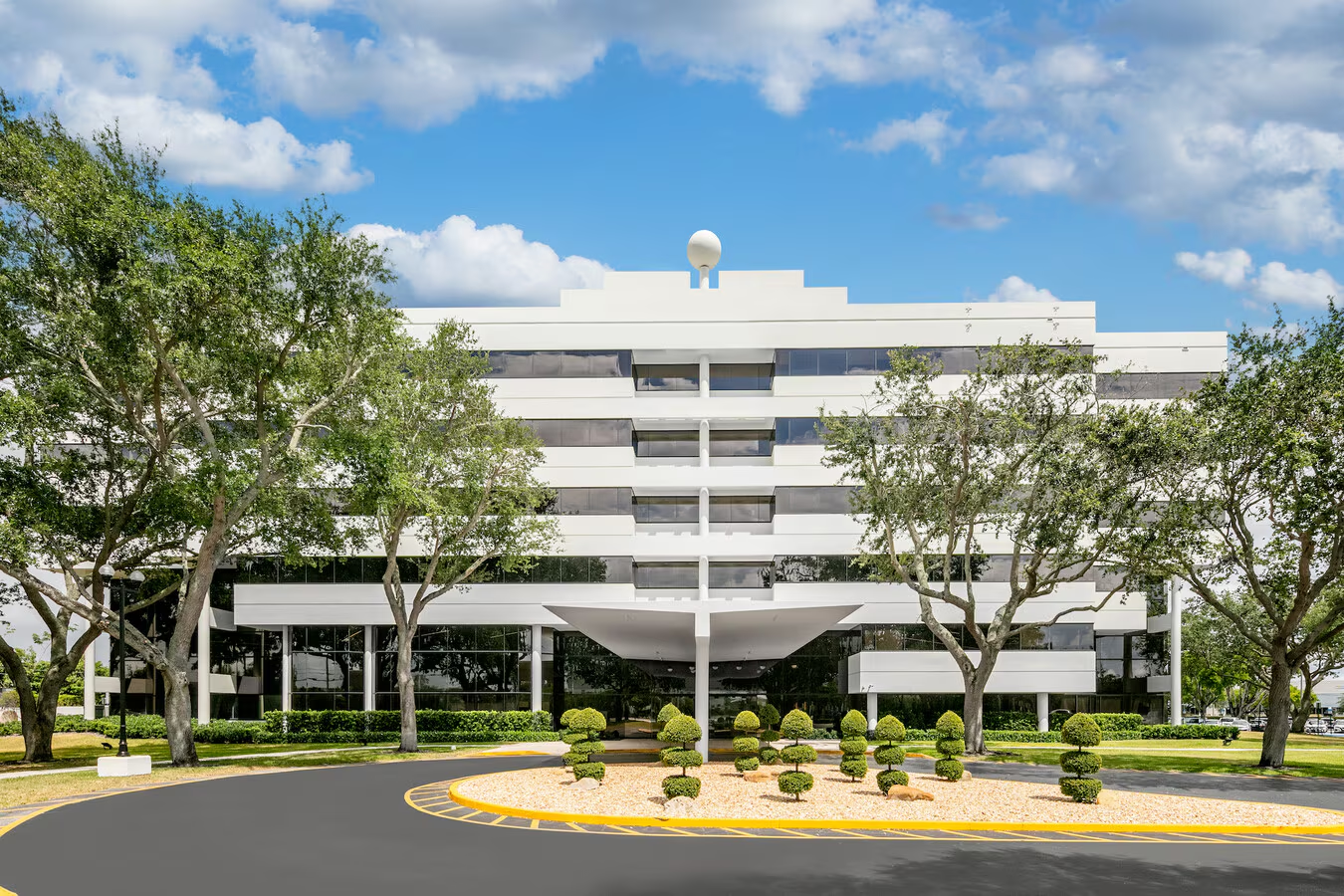
Photo Credit: By Dori (Own work) [CC BY-SA 3.0 (https://creativecommons.org/licenses/by-sa/3.0)], via Wikimedia Commons
More Newsletter Stories:
Commercial Real Estate Rainmaker